Wildfire: Friend or Foe?
On November 24, Shasta Environmental Alliance hosted the Wildfire: Friend or Foe presentation in downtown Redding. With sounds of revelry from the nearby launch of the new Redding Public Market drifting in the background, Kalyn Nash, project coordinator for Western Shasta Resource Conservation District, and Jonathon Freeman, co-founder of Native Roots Network, offered a multi-perspective exploration of California’s history and relationship with fire that was informative and thought-provoking.
Kalyn opened the presentation by identifying the factors that make California prone to wildfire, namely its Mediterranean climate, history of fire suppression (resulting in expanded fuel loads), and development in the wilderness urban interface (WUI). Climate change contributes an additional layer of complexity and uncertainty about future fire behavior by making conditions hotter and drier.
Evolving with Fire
Before European settlement, California experienced periodic, low intensity wildfires that kept ecosystems healthy and in balance, a natural cleanse for the forests. From redwoods and mixed conifer forests to oak woodlands and chaparral habitats, California native plant communities have relationships of dependence, resistance, and adaptation to fire due to millions of years of co-evolution. The Indigenous people of this land not only deeply understood these relationships, they used fire to enhance the landscape for various human, plant, and wildlife benefits, because, as Jonathon pointed out, the fact that fire is an essential part of the ecosystem is not new knowledge, it is “(k)new knowledge.”
Working with Fire
As the understanding of fire’s essential role in ecosystem health gained acceptance by Western science, the call for reintroducing intentional fire to our landscapes has been increasing in recent decades, and Jonathon helped us understand the differences between prescribed burning and cultural burning by reviewing the definitions provided in the Karuk Tribe’s Good Fire Report II. While both types of burns achieve many of the same benefits, such as fuel reduction, habitat restoration, control of invasive species, and restoration of forest and watershed health, the development and implementation of prescribed burns are in accordance with state and federal laws and review processes. Cultural burning, on the other hand, is the inherent right of Indigenous people to use fire for not only the previously listed benefits but for many more objectives, including cultivation of traditional foods and materials, as well as spiritual, religious, and community ceremony. Guidance for cultural burns comes from Tribal and Traditional Indigenous Law which is rooted in the holistic knowledge of the land.
Rethinking our Relationship with Fire
Kalyn continued the presentation with an overview of the history behind the U.S. policy for fire suppression that has led to decades of fuel build-up in our nation’s forests. In 1910, a catastrophic wildfire commonly known as the Big Burn led to the establishment of the 10 a.m. rule, which stated that all fires must be under control by 10 o’clock the day after they are detected. Kalyn alluded to the hubris of this rule by comparing it to attempting to hold back the ocean during hurricane season. Preventing all future wildfires is impossible, but mitigating human-caused catastrophic ones is within our abilities. Paying attention to red flag warnings and being mindful of our surroundings and actions can go a long way towards preventing unnecessary and potentially deadly fires. In 2024 alone, nearly 600 wildfires were caused by vehicles.
We know wildfire will continue to be part of our lives, but it doesn’t have to be a reason for our demise. Protecting ourselves, our loved ones, and property requires preparation. Kalyn shared the current guidance for defensible space and home hardening.
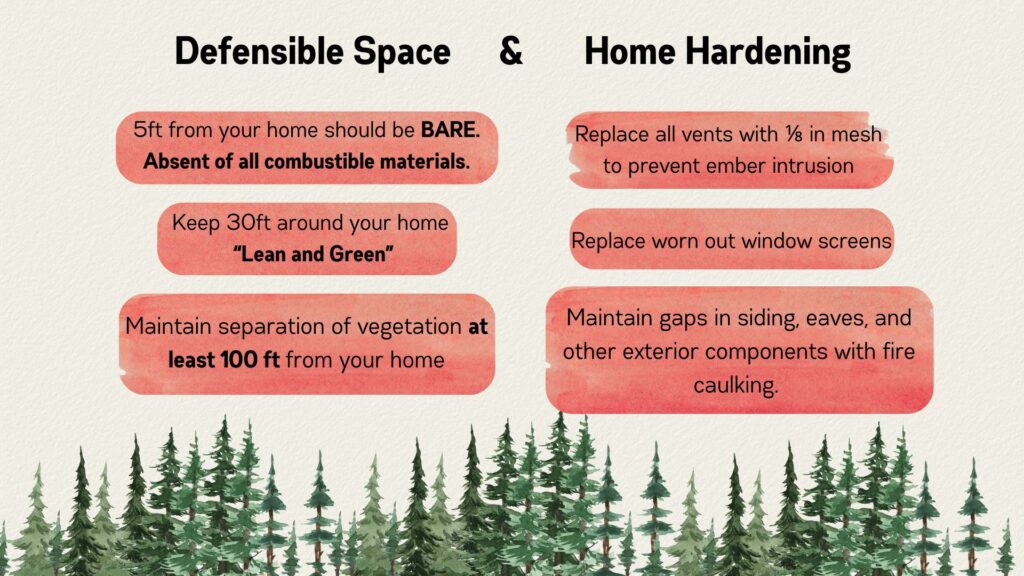
She also reminded us of the importance of having an evacuation plan and staying connected to alert systems like Watch Duty. Additionally, it is important to get to know our neighbors and establish plans to assist the most vulnerable amongst us. In times of crisis, it is our community that comes to the rescue when emergency services are overloaded.
We are grateful to Jonathon and Kalyn for taking time out of their busy lives to share this invaluable knowledge with our community. This presentation provided greater context for understanding our relationship to wildfire. Often the fear of loss overrides our understanding of the beneficial and essential role of fire in our landscapes.
Additional resources shared during the presentation:
Tending the Wild: Cultural Burning
California Fire Resource Guide
Images: Kalyn Nash